GREAT MOTHERS OF THE WORLD. “She Who Rides the Lion: From Nanā to Durgā Across the Silk Road”
- Ekata Nithya

- Mar 31
- 42 min read
Updated: Apr 4

Studying ancient cultures reveals a universal language of signs and symbols—an archetypal code through which distant civilizations, across continents and epochs, expressed their understanding of the sacred.
Within this symbolic continuum, we encounter the keys that allow us to approach the spiritual inheritance of our ancestors with greater depth and clarity. This text turns toward one of the most ancient and enduring feminine archetypes of the Turkic world: the goddess Umai.
Between the 4th and 12th centuries, among the Altaians and the broader Mongol–Turkic peoples, the vital and creative force of the heavens was personified in the figure of Umai. She appears across traditions under many names—Uma, Omai, Ymai, Ubai, Sangai, Natigai, Nachigai-eke, Otyuken, Etugen, Etugen-ehe, Itoga, Iroga—and is invoked through epithets such as Umai-iche, Mai-ana, Pay-ana (“rich, benevolent mother”), and Ulug Ak Ine (“Great White Mother”).
In her essence, Umai resonates with the primordial Turkic cosmogonic figure Ak-Ena—the White or Holy Mother who dwells in the primordial waters. As a celestial feminine presence of the Upper World, she is understood as the source of life itself: the generative intelligence through which existence emerges, is nurtured, and sustained.

Umai — The Celestial Mother, Womb of Sky and Earth
Before language separated meaning, before cultures took form, there was a single current through which the sacred revealed itself—through symbol, through rhythm, through the body of the Earth and the vastness of the Sky.
Within this primordial memory, the Mother appears.
She is known across time, across lands, across names—but her essence remains untouched.
Among the Turkic and Mongolian lineages, she is Umai.
Ymai. Umaiya. Omai. Etugen.
Not merely a goddess, but the living field of generative intelligence—the womb through which life descends, takes form, and is sustained.
She is the breath within the child, the unseen force that guards the threshold of birth, the luminous matrix that nourishes existence from within.
Ancient peoples did not worship her as distant—they lived within her.
She was the fertility of the land, the abundance of herds, the protection of children, the continuity of the lineage. The ever-present Mother, both vast and intimate.
In her form, symbols speak.
In one hand, the circle.
In the other, the crescent.
Kün — Ay.Sun — Moon.
Not as opposites, but as a union held in perfect awareness.
The circle—wholeness, origin, the unbroken field.The crescent—becoming, cycle, the unfolding of time.
Together, they reveal a deeper law: creation is not linear, but rhythmic. Not divided, but relational. Not fixed, but alive.
This gesture, repeated across images and across cultures, is not accidental. It is remembrance.
A language older than doctrine, carried through form.
To see Umai is not only to look at a figure of the past—but to recognize a pattern that still moves within consciousness itself.
The Mother is not gone.
She is the field in which all things arise.
Umai — The Mother and the Hidden Knowledge of the Soul
Within the symbolic language carried through ancient cultures, forms were never merely decorative—they encoded perception, cosmology, and direct knowledge of existence.
The circle and the crescent, often seen in depictions associated with Umai, can be approached as such a language.
The circle may be understood as the symbol of the Human Soul—whole, unbroken, origin without division.The upward-facing crescent, like a vessel, suggests a receptive field—a chalice of subtle forces, a womb through which creative power descends into manifestation.
In certain esoteric interpretations, this configuration has been identified with what is called the AllatRa sign—an image expressing the interaction between the Soul and the generative, life-giving feminine principle.
Within this view, Umai is not only a mythological figure, but a reflection of the Divine Feminine as creative force—the animating intelligence that gives movement, form, and vitality to existence itself.
Such perspectives also point toward an ancient understanding of the human being as dual in nature:one aspect oriented toward the eternal, the spiritual essence;the other bound to the material, instinctual, and transient.
Whether expressed through myth, symbol, or oral transmission, many traditions preserved this distinction—not as conflict, but as a dynamic tension within which consciousness evolves.
References to Kün–Ay—Sun and Moon—further deepen this symbolic field. They evoke not only celestial bodies, but complementary principles: radiance and reflection, impulse and receptivity, source and manifestation.
Across cultures, similar cosmological intuitions emerge.
There are recurring narratives of an originating sound, vibration, or impulse giving rise to the universe—often described as a sphere, an egg, or a seed: a contained totality from which differentiation unfolds. Within this living field, a formative force—frequently personified as a Great Mother—animates matter, brings order, and initiates the processes of life.
In different traditions, she appears as the Foremother, the cosmic womb, the Mother-Bird, the bearer of divine will—the one through whom potential becomes form.
Over time, much of this symbolic literacy has faded. What remains are fragments—images, names, myths—often disconnected from their experiential roots.
And yet, the reverence for the Feminine, found across continents and epochs, suggests something deeper was once understood:
that creation is not only structured—but gestated,not only formed—but nourished,not only ordered—but brought into being through a living, conscious field.
To approach Umai, then, is not only to study a goddess of the past, but to sense the echo of a worldview in which life itself was perceived as sacred, relational, and continuously arising from a subtle, maternal source.
What Did the Ancients Know That Now Feels Like Myth?
What we call “myth” today may once have been a precise language—encoded not in concepts, but in symbols, rituals, and lived experience.
Archaeological findings across ancient cultures reveal a consistent pattern: sacred signs inscribed on ceramics, worn as jewelry, embodied in figurines—often associated with women. Alongside these, burial sites of female ritual practitioners suggest that women were not peripheral, but central to the spiritual life of their communities. They were carriers of knowledge, mediators of unseen forces, and participants in rites that sustained the relationship between the human and the cosmic.
This points to a worldview in which the feminine was not merely biological or social—it was metaphysical: the manifesting, life-generating principle itself.
Within the Turkic tradition, this principle appears as Umai.
Not only as a “patron goddess,” as some early scholars translated, nor merely as a bringer of “happiness” (kut), but as something more foundational: the very life-force within the human being.
The concept of kut—understood as vitality, soul-force, or the animating principle—was inseparable from Umai. To possess kut was to be alive; to lose it was to perish. In this sense, Umai was not external—she was intimately bound to the inner condition of a person.
Traditional Turkic cosmology further describes the human being as multi-layered:tyn — the breath of life, inseparable from the body;sur — a subtle double, capable of separation;kermyos — the spirit that persists after death, in purified or corrupted form;kut — the essential life-force.
This is not a primitive psychology—it is a structured anthropology, expressed through symbolic language.
Within such a framework, the role of Umai expands.
She is remembered in folk traditions as the protector of children—present when a child laughs in sleep, guarding the threshold between worlds. Yet this is only the outer layer. Symbolically, she presides over birth in a deeper sense: not only physical birth, but spiritual emergence.
To “be born in the Spirit” was understood, in many traditions, as the true aim of human life—to transcend cyclical existence and enter a state of continuity beyond decay.
Fire becomes a key symbol here.
Ancient peoples repeatedly describe a “living fire”—not one that burns destructively, but one that generates, illuminates, and transforms. A “burning without scorching,” a “pure fire.” This is not ordinary flame, but an experiential reality: an inner intensity often associated with awakening, devotion, or direct contact with the sacred.
The association of the Mother Goddess with fire—Mother Fire—points again to the same principle: a generative heat, a fertile force, a presence that gives rise to life both materially and spiritually.
In the Turkic cosmological order, Umai stands alongside Tengri, the Eternal Sky. She is described as his counterpart, even his consort—yet not subordinate. Rather, she contains and expresses his power in manifest form.
Creation itself is described with striking simplicity:Blue Sky above, Brown Earth below, and the human being arising between them.
This vertical axis—heaven, earth, human—is not unique to the Turkic world. It appears, with remarkable consistency, across civilizations.
In ancient Egypt, the goddess Nut embodies a parallel principle. She is the cosmic mother—the vault of the heavens, the one who births the stars, the container of the visible and the invisible. Her body forms the threshold between worlds: the eternal and the transient, the unseen and the manifest.
Such correspondences are not necessarily evidence of direct transmission—but they do suggest a shared mode of perception.
A way of seeing the universe not as inert matter, but as layered, alive, and structured through relationships between forces—often expressed through the language of the Feminine and Masculine, Sky and Earth, Form and Source.
What, then, did the ancients know?
Perhaps not in the analytical sense we prioritize today—but in another mode entirely:
They knew how to read the world symbolically.They experienced consciousness as layered.They perceived life as animated by an underlying force.And they encoded this knowing into myth—not to obscure it, but to preserve it.
What appears to us as a fairy tale may be a fragment of that transmission—a memory, waiting to be recognized rather than believed.

Conscience, Kut, and the Inner Law of Being
In the worldview of the ancient Turkic peoples, to live “according to Tengri” was not merely to follow an external doctrine, but to align with an inner law—what we might call conscience.
Conscience was not understood as fixed or guaranteed. It could be innate, cultivated, diminished, or even lost. This alone points to a nuanced understanding of the human condition: that a person stands between possibilities. One may attune to the voice of conscience—aligning with a higher, ordering principle—or turn away from it, becoming governed by more instinctual, fragmented impulses.
This reflects an early articulation of human duality:a tension between the spiritual and the material,between awareness and automatism,between what one knows inwardly and how one chooses to live.
The word “conscience,” rooted in older linguistic strata, carries the meaning “to know,” or more precisely, “to know within.” Not knowledge as accumulation, but as recognition—an inner knowing of truth.
Within this framework, ancient knowledge was not abstract. It was experiential, embodied, and oriented toward understanding both the visible and the invisible dimensions of existence. Human beings were not perceived as merely physical entities, but as multi-layered—participants in a broader, structured cosmos.
Central to this understanding is the concept of Kut.
KUT is described across Turkic and Siberian traditions as the life-giving force within a person—the animating essence that allows life, awareness, and vitality to manifest. It is not reducible to a single definition; rather, it intersects with what later traditions might call soul, spirit, or vital energy.
Among the Altaians and Yakuts, kut was believed to enter a human being from beyond—much like a seed or a breath—filling the individual with divine vitality. Linguistically, it is also associated with happiness, fortune, and well-being, suggesting that to be aligned with this life-force was to exist in a state of inner coherence.
More detailed anthropological accounts describe the human being as composed of multiple interrelated aspects:
the mother-soul (iye-kut) — connected to higher, originating realms,
the vital and psychic force (sur) — governing animation and perception,
the earth-soul (buor-kut) — bound to the material body,
the air-soul (salgyn-kut) — subtle, diffuse, and mobile.

At death, these aspects were believed to return to their respective domains—sky, earth, air—indicating a cyclical and distributed model of existence rather than a singular, fixed identity.
Within such a system, life carried inherent responsibility. Thoughts, words, and actions were not isolated events, but movements within a larger field of order. To live consciously meant to remain in right relation—to Tengri, to the world, and to one’s own inner knowing.
Here, the figure of Umai takes on deeper significance.
If kut is the life-force within the human being, Umai may be understood as its source, guardian, or mediator—the maternal principle through which life is bestowed, sustained, and protected. This is why she appears in traditions as the protector of children, the companion of the soul, and the unseen presence near the threshold of life.
Yet symbolically, her function extends further: she represents the transmission of primordial knowledge itself—preserved not through doctrine, but through image, myth, and lived relation.
Across cultures, this pattern repeats: the deepest knowledge is carried through the Feminine—not as gender, but as principle. The Mother, the Foremother, the generative field through which existence is continuously brought into being.
Even in the rock art of Altai, where anthropomorphic figures appear with outstretched arms and wide stance, one senses more than depiction. These are not simply images, but gestures—encoded forms pointing toward a way of understanding the human as a bridge: between heaven and earth, between the visible and the invisible.
What remains today are fragments—terms like Kut, names like Umai, symbols carved into stone.
But behind them lies a coherent vision:
That life is given, not owned.That consciousness can align—or fall out of alignment.That the human being is layered, relational, and permeable to forces beyond immediate perception.And that true knowledge was once understood not as information—but as a state of being.

From Consciousness to Being
At a certain depth of inquiry, a recognition begins to arise:
that beneath the diversity of myths, names, and traditions, there is an underlying intuition of unity—that existence is not fragmented, but whole.
Within this perception, the recurring image of the Mother Goddess across cultures takes on a different dimension. She is not merely a figure of belief, but a symbol of a universal principle—one that nurtures, sustains, and gives life without distinction.
Across folk traditions, she is remembered as loving, protective, and ever-present. A source from which life flows and to which it remains connected.
Over time, however, many of these symbols have been reinterpreted through narrower lenses. Modern readings often reduce ancient goddesses to functions tied primarily to fertility, family well-being, or earthly concerns. While these aspects exist, they do not fully account for the depth these figures once carried.
A more layered view suggests that such archetypes may also point toward an inner process—what could be called a form of spiritual birth.
Not a literal transformation into another being, but a qualitative shift in consciousness:from identification with the transient, toward alignment with what is perceived as enduring or essential.
In this sense, the “care” attributed to goddesses can be understood symbolically—as guidance, protection, or orientation toward inner development. The language is mythic, but the referent may be experiential.
Across different traditions, similar figures appear—Isis, Inanna, and others—each embedded in their own cultural and historical context, yet often carrying overlapping themes: descent and return, death and renewal, protection and initiation.
Rather than assuming a single historical origin or uniform interpretation, it may be more accurate to see these parallels as expressions of shared human attempts to articulate complex inner and cosmological experiences.
What persists, even through fragmentation and reinterpretation, is the symbolic vocabulary itself.
Signs, gestures, and archetypal forms continue to surface—on artifacts, in stories, in memory. Whether understood literally, metaphorically, or experientially, they suggest that earlier cultures engaged with dimensions of life that are not always foregrounded in modern frameworks.

Across cultures, people preserve different images—but their essence converges toward one principle: divine Love.
The Mother of God, in this sense, is not confined to a single form or tradition. She is the living expression of a force through which connection is restored—through Love, the human being remembers and re-enters communion with the Divine. Through the Soul, this forgotten continuity becomes accessible again.
What is described as the “Mother” can be understood as the creative, life-giving aspect of this Love—the generative power through which existence is sustained and through which transformation becomes possible.
Across time, knowledge about the human being and the structure of reality was transmitted in symbolic, mythic, and experiential forms. Whether preserved clearly or in fragments, it consistently points toward the same orientation: not outward, but inward.
Yet the human tendency has been to seek strength externally—in temples, sacred architectures, and designated places of power. These can serve as supports, but they are not the source.
The central insight, repeated across traditions, is more demanding:
that the source of what is sought—strength, meaning, Love—is already present within.
Not as metaphor, but as ontological claim.
What is referred to as the Soul is understood as that dimension of the human being which is not transient. It is not constructed, not acquired, and not diminished by circumstance. It is described as originating from the Divine, and therefore sharing in its fundamental quality.
If God is understood as Love, then this Love is not something external to be reached—it is something to be recognized as already present at the deepest level of one’s being.
The movement, then, is not toward acquisition, but toward alignment.
Not toward becoming something else, but toward realizing what has always been there.

The Connection of the Mother-Ancestor Umai with the Earth and the Sun
The image of the Mother-Ancestor deity Umai was intimately linked with two fundamental aspects of the natural world: the Earth and the Sun.
The Earth was venerated in all its forms—caves, mountains, ravines, trees, and bodies of water. Wherever the land was fertile and abundant, it became a locus of worship. The vast surface of the Earth was seen as the body of the Mother Goddess, and for this reason, people treated it with the utmost reverence. Tearing grass or flowers, digging the soil with sharp tools, or disturbing natural formations was strictly forbidden, reflecting a deep ecological and spiritual consciousness recorded among the ritual practices of Turkic-Mongolian peoples.
Similarly, the Sun—or the fire of the hearth—was revered as the visible manifestation of Umai’s life-giving force. It was the source of warmth, growth, and vitality, sustaining the cycles of nature and life.
Umai was believed to care not only for humans but for all living beings. She ensured that animals and birds were fruitful and well-nurtured: a white mare would give birth to a snow-white foal, a black crow to a noisy crow, a green bird cherry to a sweet bird cherry. In this way, her guardianship extended across the entire web of life.
Caves held a special symbolic significance. They were considered the Mother’s Womb, sacred spaces where the sulde—the soul or life essence of future children—was stored. Just as the womb nurtures life, the caves were seen as vessels of potential, a place where spiritual and physical vitality originated and was safeguarded.
Through these connections, the worship of Umai reflects a profound understanding: the Earth, Sun, and all living beings are interwoven in a sacred matrix, guided and sustained by the nurturing, generative power of the Mother-Ancestor.

The Connection of the Mother-Ancestor Umai with the Earth and the Sun
The image of the Mother-Ancestor deity Umai was intimately linked with two fundamental aspects of the natural world: the Earth and the Sun.
The Earth was venerated in all its forms—caves, mountains, ravines, trees, and bodies of water. Wherever the land was fertile and abundant, it became a locus of worship. The vast surface of the Earth was seen as the body of the Mother Goddess, and for this reason, people treated it with the utmost reverence. Tearing grass or flowers, digging the soil with sharp tools, or disturbing natural formations was strictly forbidden, reflecting a deep ecological and spiritual consciousness recorded among the ritual practices of Turkic-Mongolian peoples.
Similarly, the Sun—or the fire of the hearth—was revered as the visible manifestation of Umai’s life-giving force. It was the source of warmth, growth, and vitality, sustaining the cycles of nature and life.
Umai was believed to care not only for humans but for all living beings. She ensured that animals and birds were fruitful and well-nurtured: a white mare would give birth to a snow-white foal, a black crow to a noisy crow, a green bird cherry to a sweet bird cherry. In this way, her guardianship extended across the entire web of life.
Caves held a special symbolic significance. They were considered the Mother’s Womb, sacred spaces where the sulde—the soul or life essence of future children—was stored. Just as the womb nurtures life, the caves were seen as vessels of potential, a place where spiritual and physical vitality originated and was safeguarded.
Through these connections, the worship of Umai reflects a profound understanding: the Earth, Sun, and all living beings are interwoven in a sacred matrix, guided and sustained by the nurturing, generative power of the Mother-Ancestor.

It was believed that the first people and animals came out of the "womb" of the earth - the cave, it gave life to trees and grasses.
The Buryats, for example, chose a special cave and carefully concealed the location of this sacred place from prying eyes.
3 Buryat sacral caves
Today it is known exactly where 3 sacred caves of various Buryat peoples are located:
1. Stone-temple on Olkhon Island, Lake Baikal
2. Dayan Derkhi in Khuvsgel aimag, Mongolia
3. Ekhyn Umai in Alkhanai, Aginsky BAO, Transbaikalia

The tradition of asking for a child at the cave
The tradition of asking the cave for the sulde (soul) of a child has been well preserved to this day.
And now childless women visit, for example, the cult place Alkhanai, which is a large mountain complex where the sacred cave Ekhyn Umai is located.
A woman needs to climb into this small cave and chip off a piece of stone - the soul or fetus of the unborn child.
And after a woman gives birth to a child, she returns to Alkhanay to the cave and brings something in gratitude to the goddess Umai, in the cave you can see child ren's clothes, toys, candles, etc.

Ritual for health and wealth
Today, the idea has also been preserved of receiving not only a sulde child from the caves, but also grace in the form of prosperity, health, etc. After all, the mother goddess is fertile with all the gifts of this world.
Therefore, the caves are visited by both men and women who already have children. In Alkhanai, it is believed that the one who crawls through the Ekhyn Umai cave will become healthy, rich and have many children.
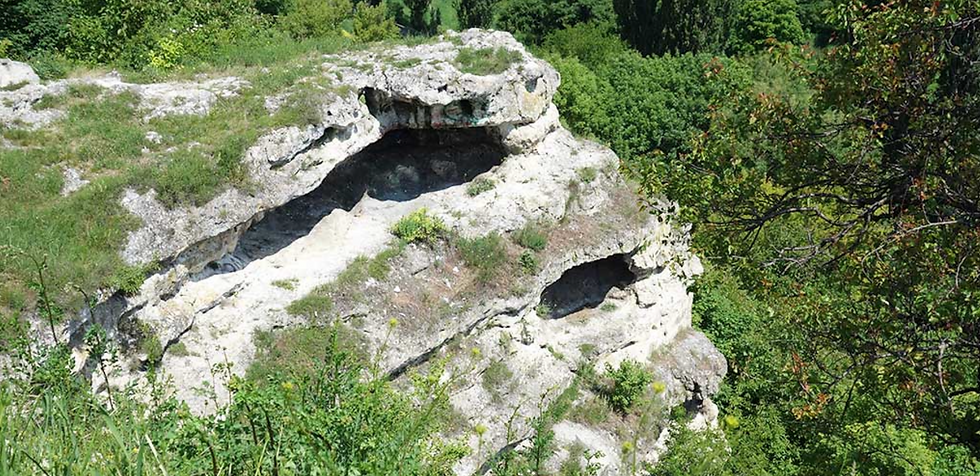
Caves in Crimea
The existence of such sacred caves is also known in the Crimea.
The ancestors of the Crimean Tatars said that “Goddess Umai guards the cradles with the souls of future children who are in a mountain cave, and the cave is guarded by the Master of the mountain, an Elder white as a harrier.”
Whether it was any one cave or each settlement or group of settlements had their own sacred places is not known for certain. According to one version, the Umai cave was located in hard-to-reach places of the Basman mountain range.
Coastal cleft - maternal loins
The coastal fissure also, due to its shape, resembling a female genital organ, was the object of worship of the Mother Goddess among some Turkic-Mongolian peoples.
Honoring Trees - Mother Tree
Another way to worship the mother goddess Umai was the veneration of trees.
According to this custom, the sulde of a person is associated with a tree, he was called the Mother Tree.
In some peoples it is larch, in others it is birch. The ritual itself could differ among different nationalities, but its essence is the same for everyone. The trees were the embodiment of the mother goddess, and through the worship of a particular tree, a person turned to the goddess Umai with some kind of request.

Among the Buryats, for example, a young, strong tree was chosen for the ritual, girded with a strip of matter or a ribbon, lit a lamp and walked around several times, setting out their requests for the birth of a child, longevity or well-being.
And among the Yakuts and Tuvans, larch was always revered, a childless woman spread a white horseskin near the larch, stood on it and prayed, asked to send childbearing, smeared the tree with oil.
As you can see in the photographs, the ritual of tying matter on trees is alive and extremely common to this day.
It migrated to modern shamanism, ribbons are tied on trees in special places of power, such as around healing springs, etc. This is how they honor the spirits of the area, turn to them with their personal requests.
Birch mother tree in the forest, Arshan,
Reverence of the Mountains - Mother Mountain
The worship of mountains also belongs to the cult of mother earth. If the people lived in the mountains or near the mountains, then the mountains became the object of worship for the earth.
Prayers and rituals were held in the mountains, and the highest mountain was called Mother Mountain, and prayers were brought to her asking for well-being and childbearing.
For the Altaians, for example, "mountains and waters, forests and rocks, gorges and valleys, inextricably linked by one reviving spirit, is the creature Altai ... rich Altai abounding in animals, rich Altai giving food."
And the highest mountain Belukha is considered the habitat of the goddess Umai. And among the Mongols, such mountains are Khangai.

Mount Shamanka and Fertility Rituals: The Stone Mother Umai
The worship of the Mother-Ancestor Umai extended far beyond mountains and natural formations. In many regions, large boulders, stones, or carefully carved stone statues served as focal points for fertility rituals and reverence for the divine feminine.
In Khakassia, one of the most remarkable examples is the ritual stone statue known as Ulug Khurtuyakh tas—the Great Stone Mother. This figure dates back to the Okunev culture, around the end of the 3rd to the beginning of the 2nd millennium BCE. Originally standing in an open field near the village of Ankhakov, the statue served as a site where locals performed ceremonies seeking fertility, prosperity, and protection under the Mother Goddess.
In 1954, the statue was moved to the Khakassian Republican Museum of Local Lore, but in 2003, at the initiative of the public, a museum-reserve named “Khurtuyakh tas” was created near Ankhakov. The statue was returned to its original location, now housed under a protective pavilion, allowing visitors to connect with its sacred energy once again. Today, it continues to be revered by the people of Khakassia as a symbol of maternal power, vitality, and collective well-being.
Archaeologist A.N. Lipsky, who documented the statue and its rituals, provides a vivid account of its continued spiritual significance:
“In the courtyard of the Abakan Museum, within the collection of ancient sculptures, stands the Khurtuyakh tas—a sandstone obelisk representing a stone old woman. The figure has a sculpted face and a well-shaped belly of a pregnant woman, symbolizing fertility and life. A young Khakass woman, standing before the statue, held a bowl of araka (milk vodka) to the mouth of the stone figure. The mouth of the statue was richly smeared with sour cream, while birch bark trays on the ground held food, araka, and abyrtkha—a traditional bread drink. The woman whispered prayers to Khurtuyakh tas, bowing deeply. Later, she explained that she had been married for ten years without children and came to seek the statue’s blessing for fertility. Such rituals illustrate the enduring reverence for Umai as the guardian of motherhood and life.”
Through statues like Khurtuyakh tas, the ancient worship of Umai is made tangible. The divine feminine was not only conceptual but physically present in the environment, connecting people with the rhythms of the Earth, the cycles of life, and the sustaining force of creation itself.

In the photo on the left is the “Great Stone Mother” in the modern covered pavilion of the museum-reserve, behind her you can see a lot of children's toys, and in front of the stone there are ritual gifts - milk, bread, sweets, etc., on the right - a Khakass woman performs a ritual “feeding” at the statue even before moving it to the museum
Worshiping Water - Mother River or Mother Lake
Mother River or Mother Lake, as a source of life, also occupies an important place in the traditions of worship of the Goddess Umai.
She was revered in the form of water, as the bearer of potential life forms that could take birth in the earthly world. Rivers flowing in the area or lakes became sacred and rituals were performed around them.

Modern statue Mother River Kyngyrga, Arshan, Buryatia
Cowrie shell - the female amulet of the Goddess Umai
Umai's symbol associated with the worship of water is the cowrie shell.
This shell of a mollusk, resembling in its form the female genitals, it was believed that fertile power lives in such a shell.

Worship of the Sun: The Golden Mother’s Womb
In contemporary thought, the Sun is often associated with masculine energy and the Moon with the feminine. Yet in ancient Turkic-Mongolian culture, the Sun was conceived as a mother-progenitor, a life-giving force intimately connected to creation. It was revered as the “golden maternal womb” or “maternal golden organ”, embodying the generative power of the divine feminine.
As the researcher Batoeva D.B. notes:
“The light in the cave is the sacred substance of solar nature (sulde), which passes from one womb (cave) to another (female). In this context, the cave serves as a container—a stone vessel—that stores and protects this light until it is ready to enter the mother’s womb.”
In this worldview, the Sun was not distant or abstract. It was a nurturing, protective, and active principle, intimately tied to the cycle of life. The golden light of the Sun was seen as a sacred, generative force, safeguarded in nature and transferred through ritual and the female body—the conduit for life itself.
The Sun as maternal reflects a profound cosmological insight: creation originates from a divine source that is both nurturing and powerful, sustaining the world through a union of celestial and earthly forces.
Worship of the sun and fire
The sun and the manifestation of fire in general, the hearth, for example, or the fire were the object of worship and veneration of the mother goddess Umai, along with her earthly images - caves, mountains, water, etc.
Rituals and beliefs with fire
The fire was treated with trepidation and various beliefs were observed, such as that it was impossible to extinguish the fire with water, sit with legs stretched out to the hearth, stir the fire with anything sharp, straighten the coals with your foot, etc.
Every time before eating they made a “treat” of fire. And leaving the house, the fire was left smoldering.
In the appeals of shamans during the rituals performed for childless families, it is precisely the appeal to the female image that sounds:
“The great hearth of fire, the great creator of fate, descended from her children, many of whom the fire bends, highlight from their wealth, the immensity of which bends the earth.”
Also, during the wedding ceremony, a spell was cast to the female deity of fire.
Protective symbols and amulets of solar Umai

The goddess Umai in her solar aspect was also considered the protector of pregnant women and small children.
Umai's protection was expressed through such symbols as the trident, the bow and arrow, and the shield.
Amulets with protective symbols of Umai were hung from the child's bed from his very birth.
An amulet from the Krasnoyarsk Territory in the form of a quiver with a bow, a trident, an arrow and a shield to protect a newborn (St. Petersburg Museum of the History of Religions)
Connection of the Sun and the Earth in the form of Umai
The image of the goddess Umai combined the spheres of heaven and earth. The wisdom of the ancients impresses with its fundamental simplicity.
Sparks of fire-sun penetrate into the dark bowels of the black earth and life is born. Without the sun, the earth is barren, and without the earth, the "spark of life" has nowhere to take root.
When we created the energy amulet Matma , we intuitively combined black and gold colors. We had a visualization of the symbol of the fertile maternal principle, as a thin transparent golden energy in the form of a spiral, rotating inside an absolutely black substance.
While researching the cult of Umai, for the first time I came across such a living illustration, which coincides well with my inner feeling.
๑ UMAY ANA ๑
Umai—also known as Abi Armai, Turan, Uranus, Zemela, Kebela, and other names—emerges from the ancient mythologies of the Bulgar, Turkic, Mongolian, and Finno-Ugric peoples. She is the primordial Mother-Ancestor, the source of life, spirit, and cosmic order.
According to the myths, the world egg with Tengri inside was formed from Ak Zharyk, the White Light. Before this, there was only chaos—absolute non-existence—which can be represented as an empty circle. The emergence of Tengri within the egg is marked by a dot at its center, the single point from which the Universe is born.
As Tengri awakens and exits the world egg, the Universe unfolds from this central point. The sky rises from the upper part of the egg, the Earth forms below, and Tengri separates them with the cormorant staff. Then, Tengri divides into male and female aspects, giving birth to the goddess Umai. From the interaction of Tengri and Umai, all life, beings, and entities on Earth arise.
In the world, women hold a unique power. A woman is the one who resolves conflicts without war. While men often see the world through their own eyes—focused on careers, achievements, and tangible pursuits—a woman often perceives the world relationally, through the eyes of others. She carries care, empathy, and responsibility, shaping life quietly yet profoundly.
A loving, devoted female heart can transform even the most irresponsible into a hero. Behind every great man, there is often an equally great woman who believes in him, inspires him, and nurtures his potential.
Woman is the foundation of the world. The community, the steppe, and the forest—all reflect the power and influence of the feminine. Everything under Umai-Ana’s patronage—children, family, home, beauty, harmony, arts, and culinary creativity—flows from her care.
Umai-Ana is the source of spirit, the beginning of morality. At the moment of birth, she imparts part of her essence into each child. From that moment, humanity itself becomes the highest task of every person: to live in alignment with spirit, love, and moral truth.
Turkic Woman – A Distinctive Way of Life
“In the Timur kingdom, the contrast between Iranian and Turkic women was striking. Iranian women lived under strict restrictions dictated by Muslim laws and customs, often confined to harems. Turkic women, by contrast, followed the traditions of nomadic Turkic-Mongolian society. They were free to move about, manage daily life, and did not hide their faces or hairstyles. In Iranian society, prostitution was common; in the Turkic world, women were too respected and autonomous to be reduced to such a role. These differences reflect values far deeper than mere social convention.”— Jean-Paul Roux, Tamerlane
Beyond social life, the spiritual role of women was equally profound. A woman can be a mentor and guide, but she leads in a distinctly feminine way—not through firmness or severity, as a man might, but through compassion, warmth, care, and nurturing insight.
In Turkic mythology, Umai embodies the feminine, earthly principle, and fertility. She is the patroness of warriors and the wife of the kagan, often considered the consort of Tengri, the eternal sky. References to Umai appear in runic texts as early as the 18th century. Some researchers connect her image to the Iraqi mythological bird Humay, whose shadow was believed to bring happiness to humans.
Among Turkic-speaking peoples, the belief in Umai persisted strongly. She was seen as the guardian of children in the womb, the patroness of newborns, and the protector of families. Kazakhs honor Umai-ene as the caretaker of children, while she also ensures fertile harvests, abundant livestock, and the wellbeing of the hearth. Through her, the Turkic peoples recognized the sacred and generative power of the feminine, both in society and in the cosmos.
NOW
KUBABA (KİBELE) Nana INANNA to UMAY core….
N; Nucleic, Neuron.
An》《Na.
Anlama》《Nasıl.
Understanding》《How.
AnAn, anı, ana, anla, anlama, anlak.
Moment, moment, moment, understand, understand, understand.
There is no time, no past, no future in the universe. In the sense of main, main, main, element. It's all about the moment. In short, we live what we understand.

The Dwarf Goddess of Ancient Bactriana
Some scholars suggest that the iconography of a goddess riding a lion was first introduced by the Kushana rulers, who worshiped Nana, a regional variant of the Mesopotamian Ishtar or the Persian Anahita.— Kartik Mishra, Why does the Goddess Durga ride on a lion?
While these notes do not claim academic rigor, they offer an intuitive perspective, inviting reflection on connections across cultures. In particular, they highlight analogies between the Hindu Goddess Durga and Ishtar/Inanna, suggesting a shared symbolic vocabulary and spiritual archetype.
The figure of the primitive Dwarf Goddess in Bactriana appears as a bridge between the Near East and India, linking early religious concepts across the Kushana Empire and the Indian kingdoms. This underscores how archetypal images of the divine feminine—whether in Mesopotamia, Persia, or India—traveled, evolved, and resonated across regions, centuries, and cultures.
As always, we present short writings that have no claim to academic research but, in a way that is perhaps intuitive and creative in their unfolding, have the mere aim of providing food for thought and research. The theme of the analogies between the Hindu Goddess Durga and Ishtar / Inanna is then addressed with these brief introductory notes relating to the primitive Dwarf Goddess, whose iconography seems to create an ideal connection between the Near East and India through the Indian kingdoms. .)
-The Kushana Empire (Ak hun Turks I-III century AD)

INTO ONENESS OF IT ALL
The Kushana Empire and the Iconography of the Goddess Nana
The Kushana Empire (c. 1st–3rd century AD) was a supranational state that, at its peak (105–250 AD), extended from Tajikistan to the Caspian Sea and from the Hindukush (Afghanistan) to the Ganges Valley, encompassing parts of Central Asia and northern India. Founded by the Yuezhi tribe from present-day Xinjiang, the empire maintained diplomatic contacts with the Roman Empire, the Persian Empire, and China, and served as a major hub of trade between East and West. It also ruled over many followers of Arya Sanatana Dharma residing in Hindustan.
To understand the iconographic confluence between geographically distant divinities, it is useful to examine the attributes of the goddess Nana. Known in the Greek dialect of the Kushanas as Νανα, Ναναια, Ναναϸαο, she was a female deity of ancient Bactria, representing a pan-Asian fusion:
Sumerian-Babylonian Inanna-Ishtar (Kushana form)
Persian/Zoroastrian Harahvati Ardvi Sura Anahita
Later in India, the goddess became associated with Aditi
This iconographic similarity was widespread among deities worshiped by the Kushanas. The empire’s territories included the Iranian-speaking regions of Sogdiana, Ferghana, Bactriana, Arachosia, Gandhara, Taxila, and the Mathura region of India.
Archaeological evidence shows that images of the Dwarf Goddess Nana have been found across Afghanistan, Tajikistan, Uzbekistan, and northwestern Pakistan, illustrating the extensive reach and cultural integration of Kushana religious traditions.
Umai and the Sacred Feminine: A Journey Across Cultures
From the earliest times, humans have expressed their understanding of existence through signs, symbols, and mythic archetypes. Across continents and millennia, the recurring image of the Mother Goddess reflects a shared human intuition: that life, the cosmos, and the soul are interconnected, and that a nurturing, life-giving force underpins creation itself.
Umai – The Mother Goddess of the Turkic and Mongolian Peoples
The ancient Turkic and Mongolian peoples revered Umai (also known as Ymai, Umaiya, Uma, Omai, Otuken, Otukan; in Mongolian, Etugen or Iroga) as the embodiment of the divine creative feminine principle. She is described in myths as the consort of Tengri, the eternal sky, and as the source of life, fertility, and spiritual guidance.
Iconographically, Umai often holds a circle in one hand and a crescent in the other—symbols of the Human Soul and the divine powers of Allat, respectively. These signs, found among ancient Turkic peoples, reveal a sophisticated understanding of human duality: each person possesses a spiritual nature and an animal nature, a truth encoded in ritual, myth, and sacred symbolism.
The primordial knowledge, passed through such symbols, emphasized that the goal of human life was spiritual birth—to transform from a mortal being into an immortal spiritual entity aligned with divine principles. Umai thus represents not merely fertility or motherhood in the literal sense, but the spiritual nurturing that enables humans to connect with the eternal.
The Soul and the Principle of Kut
Among the Altaians, Yakuts, Khakasses, and other Turkic peoples, the Soul (Kut) was seen as a divine life force present at birth. Multiple components—such as the Mother Soul (IIE-Kut), the vital and psychic force (Sur), the earthly soul (Buor-Kut), and the airy soul (Salgyn-Kut)—were carefully nurtured, often under the guidance of shamans.
The concept of Kut parallels Umai’s role as a patron of life and spiritual development. Through her, children were protected, adults guided, and the cosmic order maintained. Folk beliefs preserved her memory even when written texts faded.
Connection to the Earth and the Sun
Umai was intimately connected with nature. The Earth—caves, mountains, ravines, trees, water—was her body, treated with reverence. It was forbidden to harm the land, reflecting her sacredness. She was believed to care not only for humans but for animals and plants, ensuring fertility and abundance.
The Sun, too, was seen as a maternal force—the “golden maternal womb”—contrary to modern associations of the Sun with masculinity. Sacred caves stored this solar light, which could pass into human wombs, symbolizing the transfer of vital, creative energy.
Stone Rituals and Sacred Sites
Ritual stones, statues, and natural formations were central to worship. For example, Ulug Khurtuyakh Tas in Khakassia, a sandstone statue of a pregnant woman from the Okunev culture (end of the III – beginning of the II millennium BC), was a focus of fertility rites. Women offered prayers and libations at the statue, seeking blessings for children, illustrating the active role of women in spiritual life.
Caves were conceptualized as the mother’s womb, storing sulde, the soul or life substance of future children, emphasizing the symbolic link between the land, human life, and divine feminine power.
Turkic Women and Social Autonomy
The status of women in Turkic-Mongolian societies reflected this spiritual reverence. Unlike contemporaneous Iranian societies, where women were confined and restricted, Turkic women enjoyed freedom, respect, and participation in community and spiritual life. They guided through compassion, warmth, and nurturing, complementing men’s leadership through firmness and knowledge of the material world.
A woman’s influence was recognized not only in household life but also in society’s spiritual and moral guidance. Umai-Ana symbolized this principle, imbuing children with part of her spirit at birth and ensuring humanity remained the central goal of life.
Cross-Cultural Goddess Archetypes
The reverence for divine feminine principles is not unique to the Turkic-Mongolian world. Across civilizations, goddesses such as Isis, Inanna, Anahita, Aditi, and Durga share overlapping themes: protection, fertility, initiation, and spiritual guidance.
The Kushana Empire and the Dwarf Goddess Nana
The Kushana Empire (1st–3rd century AD) illustrates the pan-Asian diffusion of goddess iconography. Founded by the Yuezhi tribe of Xinjiang, the empire extended from Tajikistan to the Ganges, serving as a hub of trade and cultural exchange.
The goddess Nana, worshiped in Bactria, fused elements of:
Sumerian-Babylonian Inanna-Ishtar
Persian/Zoroastrian Anahita
Later Indian Aditi
Her image, sometimes depicted as a dwarf goddess riding a lion, parallels the iconography of Durga and shows how divine feminine motifs traveled across Central Asia and India. Archaeological finds across Afghanistan, Tajikistan, Uzbekistan, and northwestern Pakistan attest to her widespread veneration.
These parallels demonstrate a shared symbolic vocabulary: despite geographic distances, human societies encoded the life-giving, protective, and spiritual powers of the feminine in similar forms, preserving primordial knowledge across cultures.
From Consciousness to Being
Beneath the diversity of myths, names, and traditions lies an intuition of unity: that life is interconnected, and the divine feminine manifests as Love, Creation, and Spiritual Guidance.
The care attributed to goddesses, whether Umai, Nana, or Durga, can be understood as guidance toward inner development, helping humans navigate the duality of spiritual and animal nature. This care fosters spiritual birth, the alignment of consciousness with enduring truth, and communion with the divine.
Signs, symbols, rituals, and stories—though often fragmented or reinterpreted—preserve this wisdom. They remind us that the source of power, love, and guidance is within the human soul, a spark of the divine that connects each person to the cosmos.

In Mesopotamian mythology, this deity is known as Sin in Assyrian and Babylonian traditions, while in Sumerian mythology she is called Nanna. She functions as a moon god and a deity of fate, born as one of the children of the earth god Enlil.
The veneration of Nana extended far beyond Mesopotamia. Her name appears on the coins of Sapadbizes, a 1st-century BCE Scythian king, whose reign immediately preceded the rise of the Kushana Empire. On these coins, Nana is depicted in zoomorphic form as a lion, reflecting her dual role as a protector and a symbol of strength.
Two centuries later, Nana reappears prominently on the coins and seals of the Kushana emperors, particularly during the reign of Kanishka I in the mid-2nd century CE. The Rabatak inscription, carved in Bactrian and Greek, invokes Nana with warrior attributes, portraying her seated and accompanied by a lion.
Simultaneously, she was worshiped as a goddess of fertility, wisdom, and waters—especially the waters of the Indus River, known in the Avesta as Harahuati, under the protection of the Persian goddess Ardvi Sura Anahita. This iconographic and functional convergence illustrates how the divine feminine traveled across cultures, merging protective, creative, and life-giving aspects into a single archetype.

The Dwarf Goddess of Central Asian origin embodies a fascinating duality. On one hand, she anticipates the warrior aspect that becomes a constant in the Hindu Goddess Durga. On the other hand, she reflects the coincidence of love and war that is characteristic of the Sumerian Inanna-Ishtar of Babylonian mythology.
Regarding the role of the Dwarf Goddess and her feline mount, we turn to the words of the Indian archaeologist BN Mukherjee, who writes in his numismatic monograph “Nana on Lion” (published by The Asiatica Society, Calcutta):

“ The presence of the famous Babylonian-Sumerian Nana Goddess on several coins of the Kushana Empire is a well known fact. So is her identification with the ancient Akkadian-Assyrian deity Ishtar and with the Persian Goddess Anahita. Anahata (or Anahita), whose cult was perhaps not as ancient as that of Ishtar or Nana, is described in an epigraph from Susa in which she is invoked by Artaxerxes II Mnemone (405-3358 BC). According to the Babylonian astrologer Benosso (about 35-270 BC) the Achaemenid Shahinshah himself would have erected statues of Aphrodite-Anahita in the temples of the great cities of his Empire, including Bactria. She is also depicted in Palmyra on clay votive tablets while some seals found there contain the image of Ishtar. (...) ".
These sources attest to the widespread veneration of Nana and related goddesses across parts of Asia in the centuries preceding the spread of Christianity. The Babylonian Dwarf Goddess and the original Assyrian Ishtar highlight the popularity of Nana and other assimilated female deities in these regions before the beginning of the Common Era. While these ancient cults have since disappeared, the worship of Durga endures today, practiced widely and continuously across India.
The evidence indicates the presence of female cults, including that of Anahita, in territories later incorporated into the Kushana Empire and in neighboring regions such as Palmyra, an important caravan hub facilitating trade between Rome and the East—relations that the Kushanas actively cultivated and expanded.
Thus, Nana (assimilated with Anahita, Ishtar, and Durga) was historically worshiped in various regions of the Kushana realm. Her frequent depiction on coins suggests her popularity and symbolic authority across large portions of the Indian Subcontinent, reflecting how this significant Asian goddess was integrated both into Hindu Dharma and into the broader framework of Indian art.
For instance, a coin of Sapadbizes (c. 10 BCE) shows a lion, a crescent moon, and the inscription Ναναια on the reverse, emphasizing her cultic significance in that era.
SO..
The Eternal Feminine: From Umai to Nana and Durga
Across human history, the feminine principle has been a central archetype, embodied in goddesses who nurtured, protected, and gave life. From the Turkic-Mongolian Mother Goddess Umai to the Central Asian Dwarf Goddess Nana, and onward to the Hindu Durga, these figures illustrate a continuum of sacred feminine wisdom and power.
Umai: The Mother of the Turkic and Mongolian Peoples
Among the ancient Turkic and Mongolian peoples, the goddess Umai (also called Ymai, Umaiya, Uma, Omai, Otuken, or Etugen in Mongolian) was the archetypal mother figure. She symbolized the creative principle of nature, fertility, and abundance. Represented iconographically with a circle and crescent, she embodied profound spiritual truths: the circle as the human soul and the crescent as the divine powers of Allat, signifying the duality of human nature—spiritual and animal.
The worship of Umai was deeply intertwined with primordial knowledge, passed down symbolically through rituals, images, and sacred objects. Ancient Turkic texts linked her to kut—the life force within a person, synonymous with happiness, vitality, and spiritual essence. Through her guidance, humans were taught to cultivate spiritual birth, aligning with eternal truths beyond the material world.
Umai was also associated with natural elements: the Earth, caves, mountains, trees, and water were regarded as her sacred manifestations. Fire, as a hearth or sun, represented her solar aspect—the "golden maternal womb." In some regions, stone statues and monoliths, like the Khakassian Ulug Khurtuyakh tas, served as focal points for fertility and life-giving rituals, reflecting her guardianship over humans, animals, and plants alike.
The Kushana and Central Asian Dwarf Goddess
In Central Asia, the veneration of the Dwarf Goddess offers a fascinating parallel. Known in Mesopotamia as Ishtar/Inanna and later as Nana in Kushana Bactria, this goddess embodies the intersection of love and war, anticipating the martial aspect of the Hindu Durga.
The Kushana Empire (1st–3rd century CE) extended from Tajikistan to the Caspian Sea, and from the Hindukush to the Ganges valley, connecting Central Asia and India through trade, cultural exchange, and religious integration. The goddess Nana, often depicted seated on a lion, represented fertility, wisdom, waters (especially the Indus), and warrior attributes. She appears on coins of Sapadbizes (c. 10 BCE) and Kushana emperors, reflecting her broad cultic influence.
Indian archaeologist BN Mukherjee notes that Nana’s lion mount and iconography create a bridge between the Near East and India, illustrating the fusion of Mesopotamian Inanna-Ishtar, Persian Anahita, and Indian Aditi. This demonstrates a cross-cultural continuity in the representation of divine feminine power—protective, life-giving, and spiritually transformative.
Durga: The Living Legacy
The archetype reaches its living form in Durga, still widely worshiped in India today. Like Umai and Nana, Durga embodies protection, fertility, and spiritual power, blending martial and nurturing qualities. While earlier goddesses such as the Babylonian Dwarf Goddess and Assyrian Ishtar faded into history, Durga remains a vital expression of the eternal feminine, manifest in daily devotional practice and cultural life.
Continuity and Spiritual Significance
Across time and geography, these goddesses served not merely as figures of ritual or social function, but as symbols of spiritual birth and the cultivation of divine qualities within humans. They guided individuals toward alignment with conscience, the life force (kut), and higher spiritual truths. Their imagery—whether Umai’s circle and crescent, Nana’s lion, or Durga’s weapons—encoded primordial knowledge about the universe, life, and the soul.
Ultimately, the Mother Goddess archetype reflects a universal principle of divine love, life-giving power, and the nurturing of spiritual consciousness. Across cultures—from the steppes of Central Asia to the plains of India—she remains a living symbol of the human quest for connection with the eternal, reminding us that the source of power, guidance, and transformation resides within the soul itself.
MY SPACE IN TAJIKISTAN
The Kalai Kahkaha Mural (c. 800 CE, Tajikistan)
Depiction:
Seated figure, adorned in female dress and jewelry
Sitting on a full lion (not a lion protome), which signals power, protection, and divine authority
Identification:
Likely Nana / Nanaia, the same goddess worshiped during the Kushan Empire (1st–3rd century CE)
Coins from Kushan rulers like Kanishka I depict her in similar form: lion mount, crescent moon, warrior-mother attributes
Cultural Context
Communities involved:
Kushans, Sakas, Yuezhi, Soghdians/Bactrians, Parthians—all Indo-Iranian speakers
Nana’s cult was pan-Central Asian, showing remarkable continuity
Functions / Symbolism:
Lion → strength, courage, and protective force
Female ornamentation → maternal, fertility, and divine creative power
Crescent / lunar motifs → cosmic, life-giving principles
Interpretive note:
Misidentifying the lion as a protome or assuming the figure is male reflects modern biases that obscure the primordial feminine principle
Significance
PConfirms that Nana/Nanaia is not only a Mesopotamian or Kushan deity; her worship migrated and adapted across regions
Demonstrates iconographic continuity of the goddess archetype: Inanna-Ishtar →
Nana → Umai → Durga
Suggests that Central Asian murals were a visual medium for preserving spiritual knowledge, not merely decorative art

Devi Ambā: The Goddess with the Lion ..so as you can see She is just like Umai holding Sun and Moon on her hands Here what I am trying to describe shows how the Four-Armed Goddess Nana of Panjikent and her iconography are a bridge between Central Asian and Vedic spiritual symbolism, reflecting both cosmological and inner processes.
INTO THE SOURCE DEVI
MY NANAI
A Masterpiece ancient silver sculpture of Mahishasura Mardini(slayer of Mahishasura)
Dated: ~7-8th century CE in Pakistan
IN KULACUDAMANI DEVI'S SOURCE TEXT NIGAMAS
ACTUALLY THE IMAGE OF MAHISA-MARDINI IS HOWEVER DIFFERENT FROM THAT OF OF DURGA.MAHISA MARDINI ACCORDING TO KULACHUDAMANI HAS EIGHT HANDS HOLDING ON THE RIGHT SIDE ,CHAKRA((DISCUS),KHADGA(SACRIFICALSWORD),BANA(ARROW),TRISHULA(TRIDENT), AND THE LEFT SIDE KHADGA,CHARMA(SHIELD),DHANUH(BOW), AND TARJANI MUDRA(VIDE POST).DEVI SAID TO BE OF BLACK COLOR SO IS UNIVERSE!! PLACED ON THE BODY OF BLACK BUFFALO!!!!!
The extent of Gandhara proper actually included the Peshawar valley, the hills of Swat, Dir, Buner and Bajaur, all of which lie within the northern bounds of the modern day nation of Pakistan. However the bounds of Greater Gandhara extended towards the Kabul Valley in Afghanistan and the Potwar plateau in the province of Punjab in Pakistan,
Because the woman's widely set, heavy-lidded eyes suggest Indian facial types, she may well represent a Sasanian goddess who was associated with the cult of the Indian god Siva. Known in India as Durga, and in Iran as Nana, she decapitated a demon who appeared in buffalo form.Both this and the horse rhyton were found crushed flat in tombs. Their reconstruction took many months to complete.
[Hinglaj Devi of Baluchistan(Pakistan) was also known as 'Nanai' locally and in Iran as 'Nana'. Persian godess 'Anahita' was considered another form of 'Nana'. Hinglaj Devi is one of 51 places where Sati's body part fell.]
FROM THE VERY KUSHANI ..
FROM THE VERY SOURCE
DEVI YOU ARE IN ME , I AM IN YOU
MY NANAI
-NITHYA EKATA
Here’s a structured view:
The Iconography of Nana / Durgā in Sogdiana
Four arms: Represents the multifaceted power of the Goddess—creation, protection, destruction of ignorance, and guidance of consciousness.
Holding Sun and Moon: Symbolizes her role as the regulator of cosmic rhythms, the balance of light and dark, and the duality of natural laws.
Lion mount: Not merely a beast, but the manifestation of uncontrolled Nature. The Goddess, through spiritual authority, directs the instincts and forces of the world—analogous to dṛṣṭi-sṛṣṭi in Vedanta or observation shaping reality in quantum physics.
Connection to fertility, waters, and celestial cycles: Links Nana to both life-giving forces and cosmic order, connecting human action with natural law (ṛta).
Central Asia as a Crossroads
Sogdiana (Samarkand, Bukhara) 3rd–8th century CE:
A hub of trade, cultural exchange, and religious transmission along the Silk Road.
Religions included Zurvanite Zoroastrianism, Manichaeism, Buddhism, Hinduism, and Nestorian Christianity, often borrowing Vedic and Hindu iconography.
Local populations adapted and integrated Hindu symbols—Brahmā, Śiva, Indra, Kubera—without formal orthodoxy, showing that religion was experiential, personal, and syncretic.
Philosophical Significance
The lion and the Goddess together symbolize human freedom under natural law.
Lion → Nature, instincts, chaos
Goddess → Consciousness, Spirit, higher agency
The Vedic hymn Devī Sūkta (Ṛgveda 10.125) aligns with this:
“I am the sovereign queen of all existence … I bend the bow for Rudra; I pervade heaven and earth.”
In this framework, worship of the goddess is not merely external devotion but a training of consciousness to navigate the interplay between instincts, desires, and spiritual insight.
Continuity with Earlier Central Asian Goddesses
Nana / Nanaia → Ardoksho → Ardakṣī → Umai → Durgā
Themes repeated across centuries:
Fertility and protection (Umai / Ardoksho)
Warrior power and spiritual authority (Nana / Durgā)
Cosmic balance and universal motherhood (holding Sun & Moon, lion symbolism)
The goddess in Sogdiana embodies the union of cosmic order and personal spiritual agency.
Her worship in Central Asia shows that ancient peoples recognized multidimensional aspects of consciousness, using myth, ritual, and iconography to guide the human mind toward harmony with nature and the cosmos.
The continuity of goddess worship across regions emphasizes the primordial knowledge of the feminine principle as a conduit for spiritual awakening, not just fertility or family well-being.
this situates Nanā as a trans-cultural, pan-Asian goddess, whose attributes and veneration span Central Asia and India. Key points from what you shared:
Linguistic and Cultural Layers
Sanskrit context:
Nanā (नना) appears in Ṛgveda 9.112.3 as a mother, goddess, or speech (Vāc).
The term also refers to a daughter, emphasizing the cyclical and relational aspects of feminine divinity.
Coinage and Inscriptions:
Coins of Sapadbizes (1st century BCE, Bactria) show Nanā, connecting her to political and cultural authority.
Kushan coins and seals preserve her image, emphasizing both warrior and fertility aspects.
The Rabatak inscription of Kanishka I explicitly invokes Nanā, claiming that kingship derives from her and the gods, asserting divine legitimacy.
Roles and Symbolism
Mother, patroness, and source of speech (Vāc):
She is a nurturer of life and consciousness, linking cosmic and human order.
Political and spiritual authority:
Kings attributed their legitimacy to her, showing how divine feminine power was integrated into governance and law.
Aryan language claim:
The inscription notes that the Kushans spoke an “Aryan”which is Turkic language, emphasizing continuity with Vedic cultural and linguistic heritage, even in Central Asia.
Continuity Across Regions
Nanā → Ardoksho → Ardakṣī → Umai → Durgā
Attributes conserved across centuries:
Protection and fertility
Warrior power
Cosmic and moral authority

Timeline & Lineage of Goddess Nanā
1. Mesopotamia / Sumer (~3000–1000 BCE)
Names: Inanna (Sumerian), Ishtar (Babylonian/Assyrian)
The Sumerians are a branch of the Scythian Turks. Sumerian, Hungarian (Hun), Turkish
The work Dictionnaire d’étymologie sumérienne et grammaire comparée (Dictionary of Sumerian Etymology and Comparative Grammar), published in Paris in 1975 by Kálmán Gosztonyi, is one of the most radical and comprehensive studies examining the connection between the Sumerians—the oldest civilization of Mesopotamia—and modern languages.
Tracing Sumerian: Kálmán Gosztonyi and the Common Roots of Languages
The Sumerian civilization, lost within the dusty pages of history, has left one of the greatest mysteries of modern linguistics through its cuneiform tablets: “To whom does Sumerian belong?” Hungarian linguist Dr. Kálmán Gosztonyi, who dedicated his academic career to answering this question, presented groundbreaking knowledge and evidence in this field with his work published in Paris in 1975.
A Grammatical Phenomenon: Analysis of 53 Features
In his work, Gosztonyi examined the structure of Sumerian with mathematical precision. One of the most striking results of his comparative analyses is the ratio of structural similarities between languages. According to Gosztonyi, of the 53 fundamental grammatical features of Sumerian, 51 are also present in Hungarian and 29 in Turkish.
This statistic demonstrates that Sumerian has no connection with Indo-European languages; rather, it shows a direct relationship with the Ural-Altaic language family, which is characterized by an agglutinative structure.
The author emphasizes that the way these languages derive meaning through suffixation added to word roots has been preserved without deterioration over thousands of years. (Ural-Altaic Turkish)
The Sumerian–Turkish–Hungarian Triangle: A Common Origin
Gosztonyi did not limit his work to grammar alone; he also compiled a comprehensive etymological dictionary, placing more than a thousand Sumerian words alongside their Turkish and Hungarian equivalents.
According to the author, this similarity goes beyond simple cultural exchange and indicates that these three peoples share a common origin, or that the Sumerians were a branch of Central Asian “Proto-Turkic” or “Proto-Hungarian” communities.
In particular, in his observations on the Turkish language, he draws attention to the parallels between Sumerian concepts related to natural phenomena, family ties, and numbers, and their archaic forms in Turkish.
This situation strengthens the idea that Sumerian is, in fact, an ancient ancestor of both Turkish and Hungarian.
Historical Perspective and Legacy
Gosztonyi’s work represents a challenge to the Eurocentric linguistic understanding of his time.
He defines the Sumerians not as a people who descended into Mesopotamia from nowhere, but as a civilization that came from the steppes of Central Asia, carrying its cultural and linguistic heritage. He presents evidence and arguments in this direction.
Today, Gosztonyi’s data is considered one of the primary reference points for researchers who support the “Turanian Languages” theory in Sumerology.
The unique comparison of 51 and 29 features he presents both demonstrates and reminds us that Turkish and Hungarian are not only modern languages, but also living heirs of the oldest written civilization in human history.
References
Gostony, C.-G. (Kálmán Gosztonyi): Dictionnaire d’étymologie sumérienne et grammaire comparée, Paris: Editions de Boccard, 1975.Zakar, A.: Sumerian–Ural-Altaic Affinities, Current Anthropology, 1971.Karamurat, C.: Comparative Analyses on Sumerian–Turkish Language Relations.
Roles:
Goddess of love, war, fertility, and cosmic order
Often depicted with lion mount
Key Symbolism:
Union of love and warrior power
Stars, moon, celestial phenomena
2. Iranian / Central Asian Transition (~1st millennium BCE)
Names: Anahita, Ardvi Sura Anahita
Regions: Sogdiana, Bactria, Parthian territories
Roles:
Goddess of waters, fertility, protection
Preserver of cosmic order and moral law
Transmission:
Through Zoroastrian texts and local cults
Continues feminine cosmic principle from Mesopotamia
3. Bactria / Kushan Empire (~1st–3rd century CE)
Names: Nanā, Nanaia, Ardoksho, Ardakṣī
Key Evidence:
Coins of Sapadbizes (c. 10 BCE) – Lion imagery, crescent moon, inscription “Ναναια”
Kushan coins/seals and Rabatak inscription (Kanishka I)
Roles:
War goddess seated on lion
Goddess of fertility, wisdom, waters
Legitimizing Kushan kingship
4. Sogdiana / Panjikent (~3rd–8th century CE)
Depictions:
Four-armed goddess holding Sun and Moon
Riding lion, symbolizing mastery over natural instincts (ṛta)
Syncretism:
Dual influences: Vedic Hinduism + local Central Asian cults
Connection with Zurvanite Zoroastrianism, Buddhism, Manichaeism
Function:
Spiritual guide, protector, and symbol of consciousness controlling matter
5. Indian Subcontinent (Post-Kushan, ~3rd century CE onward)
Names: Durga, Ambikā, Devi, Ārdrā
Roles:
Warrior goddess (Durga) and mother figure (Ambikā)
Cosmic authority: destroys ignorance (buffalo demon), illuminates consciousness
Continuity with Nanā:
Lion mount → inherited from Nana/Nanaia
Warrior + love/fertility → inherited from Inanna-Ishtar
Cosmic maternal and spiritual authority → inherited from Umai/Ardvi Sura
6. Underlying Principle
Across all regions, Nanā embodies:
Divine feminine principle
Connection to cosmic law and natural order
Spiritual guidance and moral authority
Maternal and warrior duality.
Goddess Nanā in Central Asia
Identity and Equivalence:
Nanā, known as नना देवी अम्बा (Nana-devi-amba) in Sanskritized Sogdian, is a Central Asian goddess whose attributes closely align with Goddess Durgā / Ambā in the Indian tradition.
In Sogdian script, her full name is rendered as nnδβ’mbn nǝnǝ-δβāmbǝn.
She embodies the archetype of a protective, warrior goddess, often associated with martial and cosmic powers.
Iconography:
Nanā is depicted with four arms, signifying her multi-faceted powers.
She is mounted on a lion, serving as her vāhana (symbolic vehicle), emphasizing courage and sovereignty.
Weapons and symbolic gestures in her hands likely parallel those of Durgā, representing her control over cosmic forces and protection from evil.
Archaeological Evidence:
A palace painting in Panjikent (near Samarkand) shows Nanā with four arms, mounted on a lion, highlighting her status in Sogdian courtly art.
A charred wooden representation from the 1st quarter of the 8th century CE, originating from Panjikent, is preserved at The State Hermitage Museum, St. Petersburg. This artifact provides valuable material evidence of her veneration in the region.
Cultural Context:
Nanā represents a synthesis of Indian and Central Asian religious motifs, illustrating the cultural exchange along the Silk Road.
Her presence in Panjikent indicates the adoption and adaptation of Indian divine iconography in Sogdian and broader Central Asian contexts.

Goddess Nanā with lion = Goddess Durgā on charred wood, Panjikent
Since Ambā (Universal Mother) is the original name and Durgā (Unassailabe) just an appellation, we conclude that Nanā Devi Ambā is indeed the same as Durgā.

Durgā killing the buffalo demon
Note that Durgā is called Nani in shrines as far as Baluchistan and Naina Devi in Himachal Pradesh. The latter variant means “Goddess with [Beautiful] eyes” which stresses the “command from seeing aspect” of the deeper intuition. Goddess Mīnākṣī, मीनाक्षी, “fish-eyed one”, also stresses the same insight.
For related goddesses in lands further off, note Nane (Armenian: Նանե, Nanė) is an Armenian mother goddess who is also the goddess of war and wisdom. She was depicted as a young beautiful woman dressed as warrior, with spear and shield in hand. This is quite like the Greek Athena, with whom she identified in the Hellenic period. Babylonian Nana and Sumerian Nanai were most likely the same goddess.
Goddess Anāhitā (अनाहिता)
Names and Origins:
Old Persian: Anāhitā is the Old Persian form of a goddess earlier known as Aredvi Sura (Ārdrāvī Śūrā), आर्द्रावी शूरा, meaning “of the waters and mighty”.
Meaning: Anāhitā means “immaculate”, closely parallel to the Sanskrit Nirañjanā (निरञ्जना).
She was a water and fertility goddess, associated with purity, prosperity, and cosmic order.
Historical Popularity:
Anāhitā was widely worshiped in Iran until the Sasanian iconoclastic reforms (224–651 CE) suppressed her cult.
Her worship indicates the influence of Devi Ambā traditions extending south and southwest of Sogdiana.
Linguistic and Cultural Connections (Sogdian Evidence):Sogdian vocabulary reveals Sanskritic origins and cultural exchange:
zrγwny / zǝrγōnē (fem. zǝrγōnǝč): green | हरिगुणी
zǝrwā: Zurwān | Śravaṇ (Time)
γwtʾynh / xwaten / xātūn: queen | evolved into Persian خاتون
smwtr / sǝmutr: ocean | समुद्र
stryc / strīč / strīšt: woman | स्त्री
rwxšn’γrδmn / ruxšnāγǝrǝδmǝn: Light Paradise | रुखसान गर्तमन
These examples illustrate the deep interplay between Iranian, Sogdian, Sanskrit, and Turkic linguistic and cultural spheres.
Association with Devi Ambā:
Anāhitā, like Devi Ambā, manifests through multiple forms: Sarasvatī (knowledge), Lakṣmī (prosperity), Pārvatī/Durgā (strength and protection).
She represents divine feminine power in its protective, nurturing, and cosmic aspects.
Geographic and Historical Influence:
Anāhitā’s cult extended across Sogdiana, Bactria, Chorasmia, Gandhara, and Mathura, encompassing modern Afghanistan, Tajikistan, Uzbekistan, and northwestern India.
Depictions on coins and seals, notably during the Kushan period (1st–5th centuries CE), show her seated on a lion, highlighting martial, protective, and fertility aspects.
She is closely linked to Harahvati Aredvi Sura Anahita, the Zoroastrian water goddess, and later merged iconographically with West Asian goddesses like Tyche and Demeter.
Iconography:
Lion mount: Symbol of courage and power, reminiscent of Durgā in Indian traditions.
Cornucopia-like palmette: Symbol of abundance and fertility in Central Asian depictions.
Four arms (in some depictions): Denotes multiplicity of divine powers.
Integration with Buddhist and regional art: The image of Anāhitā/Nana spread along Silk Road trade and cultural routes.
Legacy:
She influenced Central and South Asian goddesses, with names and forms preserved in temples, city names, and cultural memory.
Modern connections include:
Naina Devi (Himachal Pradesh)
Mumbai (named after Mahā-Ambā)
Hinglaj Nani Mandir (Balochistan)

Teshik-kala (Ancient Chorasmia), fragmentary seal impressions.


Comments